
education, resources, and advocacy
education, resources, and advocacy
Texas Balance of State Continuum of Care Program
Continuum of Care Program and Prospective Applicants
CoC Program Competition Application Materials
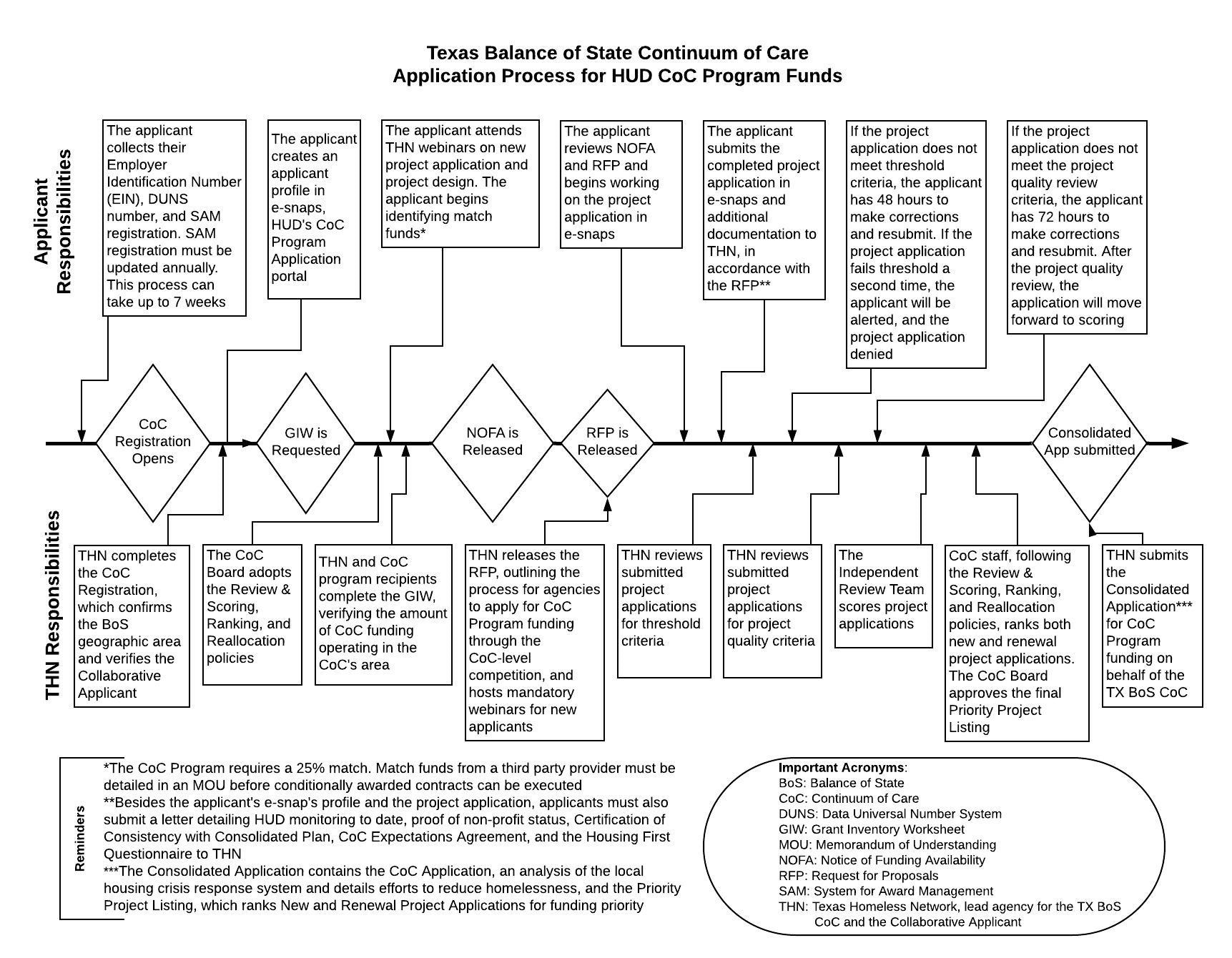
In general, the CoC program will fund Rapid Re-Housing, Permanent Supportive Housing, Joint Transitional Housing & Rapid Re-Housing (TH/RRH), Transitional Housing, Supportive Services Only, HMIS, and Coordinated Entry. To learn more about each of these activities, please click the hyperlinks above. Please note, the availability of funding and required applicant eligibility for each of the activities above is dependent on both the TX BoS CoC Request for Proposals (RFP) and the United States Department of Housing and Urban Development (HUD) CoC Program Notice Of Funding Opportunity (NOFO), or the relevant Funding Opportunity. You can learn about the release of the NOFO on the HUD website.
FY2026 CoC Funding Competition Schedule
| Local competition process OPENS | June 12, 2026 @ 9:00 AM CST |
| Local competition process CLOSES | July 7, 2026 @ 4:59 PM CST |
Local competitive application process OPENS Update coming soon.
Local competitive application process CLOSES Update coming soon.
CoC Program Competition Updates
June 12, 2026
Click here to view the FY2026 TX BoS CoC Request for Proposals (RFP)
Link to application portal (SurveyMonkey Apply (SMA))
The TX BoS CoC is currently accepting applications for FY2026 CoC Program funding June 12 through July 7, 2026 at 4:59:59 PM CST for New, Transition, and Renewal Project Applications.
- Threshold Verification submissions must be submitted for FY2026 CoC Program funding by June 19, 2026 at 7:59:59 PM CST and approved before applicants are allowed to proceed to the Local Application.
Eligible applicants can access and download the CoC Program Competition materials, including the Request for Proposals (RFP) and other new resources (including the recording and slides from yesterday’s Informational Webinar), below on this CoC Competition landing page. Applicants are strongly encouraged to review the entire RFP before beginning the application process. We welcome applications from entities THN has not previously worked with.
How to Apply:
The FY2026 CoC Program Local Application includes two required stages:
- Threshold Verification (Required for All Applicants)
- Due: June 19, 2026 at 7:59:59 PM CST
- Must be submitted and approved before accessing the Local Application (SMA) stage
- Local Application (SMA)
- Due: July 7, 2026 at 4:59:59 PM CST
- Includes completion of the full application in SMA and e-snaps
Access Application Types in SMA:
- CoC Bonus Project Application
- DV Bonus Project Application
- Transition Project Application (Renewal Recipients Only)
Applicants must ensure they access and complete the correct application type. Please review the full RFP for detailed instructions and requirements prior to starting.
CoC Program NOFO Webinar Materials
This webinar covered a high-level overview of key changes, funding details, project types, and what applicants need to know for the FY26 CoC Program Competition.
For Renewal Recipients: Currently funded CoC Program projects (i.e., renewal recipients) will receive direct communication regarding these separate Renewal Project Instructions.
June 5, 2026
FY2026 CoC Program Local Competition Opens June 12th
The Texas Balance of State Continuum of Care (TX BoS CoC) will open the FY2026 CoC Program Local Application Process on Friday, June 12, 2026, at 9:00 AM CST.
The local Request for Proposals (RFP) will be published on June 12th when Competition opens. In the meantime, prospective applicants should begin preparing now and review the key dates below.
Key Dates
- Threshold Verification Submission Deadline: Friday, June 19, 2026 by 7:59 PM CST
- Applicants who do not complete the Threshold Verification will not be eligible to move forward in the competition.
- Local Application Deadline: Tuesday, July 7, 2026, by 4:59 PM CST
Informational Webinar
THN will hold an FY2026 CoC Program Competition Informational Webinar on:
- Thursday, June 11, 2026
- 2:30-4:30 PM CST
Please register here: https://us06web.zoom.us/webinar/register/WN_EERxiS8nRuGPyX-NnXcIlw
What Applicants Can Do Now
Before the RFP is released, prospective applicants are encouraged to:
- Review HUD’s FY2026 CoC Program NOFO
- Confirm their SurveyMonkey Apply organizational profile: https://thncompetition.smapply.io/ (THN’s local application platform)
- Ensure individual and organizational access to e-snaps (HUD’s application platform)
- Begin contacting the entity responsible for approving the HUD-2991 Certification of Consistency
- Verify that their organization’s SAM registration is active
- Review THN’s New Applicant training materials:
Important Note
While we do not anticipate major timeline changes, dates may shift if HUD releases additional required documentation or instructions that affect the local process. Any updates will be shared by email and posted on this page.
If you have not already, sign up for CoC Competition Updates to receive future announcements directly.
For questions, contact txboscoc@thn.org.
June 1, 2026
- Review the official HUD FY2026 CoC Program NOFO here.
- Monitor this website regularly for announcements regarding the Local Competition process and upcoming application materials.
- If you are new to the CoC Program and have not applied before, review the New Project Application Clinic material below (under April 13, 2026).
April 13, 2026
CoC Program New Project Application Clinic – Resources Available
Resources from the New Project Application Clinic are available for organizations interested in applying as a new project under the FY26 CoC Program Competition.
- Part 1:
- Part 2:
FY26 CoC Program – Notice of Interest in Applying
Organizations considering applying as new applicants for FY26 CoC Program funding are encouraged to complete the Notice of Interest in Applying Survey linked below. The survey only takes a few minutes to complete and helps the CoC plan technical assistance and support. Completion of this survey does NOT obligate an organization to apply.
- FY26 Notice of Intent in Applying Survey: https://forms.office.com/r/9wA3fiG456?origin=lprLink
Questions or issues accessing materials may be directed to txboscoc@thn.org.
March 13, 2026
RESCHEDULED: CoC New Project Application Clinic (Two‑Part Informational Webinar)
The CoC New Project Application Clinic has been rescheduled to April 8–9. This two‑part informational webinar provides a high‑level overview of key components of new CoC project applications, frequent pitfalls, typical documentation and scoring considerations, and time for general Q&A (as time allows).
New Dates & Times (Central Time):
- Part 1: Wednesday, April 8, 2026 — 10:00-11:30 AM
- Part 2: Thursday, April 9, 2026 — 10:00-11:30 AM
Who should attend: Agencies planning to submit a new CoC project application, and staff supporting project development, grants management, and program design.
Recording: Both sessions will be recorded and shared afterward for those unable to attend live.
Register: https://us06web.zoom.us/webinar/register/WN_2cC3U1-dTFy1mWP8I1XS-Q
March 11, 2026
Join us for a two-part informational webinar to help agencies understand key components and common considerations for new Continuum of Care (CoC) project applications. We’ll provide a high-level overview of application elements, frequent pitfalls, typical documentation and scoring factors, and time for general Q&A (as time allows).
When (Central Time):
- Part 1: Wednesday, March 25, 2026 — 10:00 AM
- Part 2: Thursday, March 26, 2026 — 10:00 AM
Who should attend: Agencies planning to submit a new CoC project application, and staff supporting project development, grants management, and program design.
Register: https://us06web.zoom.us/webinar/register/WN_2cC3U1-dTFy1mWP8I1XS-Q
For questions, email txboscoc@thn.org
Visit the Resources page to view prior TX BoS CoC Program Grant Materials.
CoC Program Recipient Resources
General Application Materials/Resources
FY2026 CoC Competition Resources
- FY2026 CoC Program Notice of Funding Opportunity (HUD NOFO)
- TX BoS CoC Competition Priorities
- TX BoS CoC Expectations (Updated 6.11.26)
- FY2026 Local Competition FAQs
- FY2026 TX BoS CoC Local Application Process Cheat Sheet
- CoC Application Pre-Flight Checklist Packet
- FY2026 Local Competition Budget Validator
- FY26 CoC Competition Informational Webinar
- Supportive Services Agreement (Template)
New Project (CoC Bonus & DV Bonus) Materials/Resources
- FY2026 TX BoS CoC New/Transition Project Request for Proposals (RFP)
- TX BoS CoC New Project Budget Form
- e-snaps New Project Detailed Instructions (not yet released)
- CoC Bonus New Applicant Local Application Scoring Tools
- DV Bonus New Applicant Application Scoring Tool
- New Project Application Clinic
Transition Project Materials/Resources
- FY2026 TX BoS CoC New/Transition Project Request for Proposals (RFP)
- TX BoS CoC New Project Budget Form
- e-snaps Transition Project Detailed Instructions (not yet released)
- FY2026 Transition Project Competition Scorecards
Renewal Project Materials/Resources
- FY2026 Renewal Project Instructions
- FY2026 Grant Inventory Worksheet (not yet released)
- e-snaps Renewal Project Detailed Instructions (not yet released)
- FY2026 Renewal Project Competition Scorecards
THN Resources
HUD Resources
—————————————-
For Reference: Click to View the Texas Balance of State CoC County ListHUD CoC Start-Up Training Materials
-
-
-
- 1 Welcome and Introductions and Agenda
- 2 Eligible Participants
- 3 Eligible Costs
- 4 Eligible Costs Leasing
- 5 Eligible Costs – Rental Assistance and RRH
- 6 Matching Requirements
- 7 Financial Management
- 8 TICH Overview and Role
- 9 Grant and Project Changes
- 10 Recordkeeping Requirements
- 11 Reporting
- 12 Monitoring and Technical Assistance
- 13 Conflict of Interest
- 14 General Operations – Termination – Other
- 15 Closing Remarks
-
-
CoC Program Snapshots
Other CoC Program Recipient Resources
CoC Program-Funded Project Forms & Tools
All CoC Program-Funded Projects
-
-
-
- CoC Funded Participant Occupancy Charge (Rent) Calculator
- Internal Wellness Checklist for the Continuum of Care (CoC) Program
- THN Internal Monitoring Guidance
- Memo to File of Identified Deficiency Template
- PSH Project File Review Form
- RRH Project File Review Form
- Data Quality Monitoring Guide
- Serving Survivors VAWA Training Pt. 1: Best Practices (webinar recording)
- Serving Survivors VAWA Training Pt. 2: Coordinated Entry (webinar recording)
-
-
Rapid Re-Housing Forms
-
-
-
- TX BoS CoC RRH Eligibility Packet– v4 Please check for updates periodically
-
-
Permanent Supportive Housing Forms
-
-
-
- TX BoS CoC PSH Eligibility Packet– v4 Please check for updates periodically.
-
-
Forms Available in Spanish
Competition Application Materials
Visit the resources page to view prior TX BoS CoC Program Grant Materials.
New Applicant Resources
- So You Want To Receive CoC Funding Webinar Recording
- New Project Applicants: Developing a Strong Project to Serve People Experiencing Homelessness Webinar Recording
- CoC Competition Guide
- Supportive Services Only-Coordinated Entry FY 2019 BLANK APPLICATION
- Joint Transitional Housing and Permanent Housing Rapid Re-Housing FY 2019 BLANK APPLICATION
- Permanent Supportive Housing FY 2019 BLANK APPLICATION
- Rapid Re-Housing FY 2019 BLANK APPLICATION
New Project Materials
Renewal Project Materials
CoC Program Recipient Resources
Texas Balance of State CoC County List
HUD CoC Start-Up Training Materials- 9/20/2016
- 1 Welcome and Introductions and Agenda
- 2 Eligible Participants
- 3 Eligible Costs
- 4 Eligible Costs Leasing
- 5 Eligible Costs – Rental Assistance and RRH
- 6 Matching Requirements
- 7 Financial Management
- 8 TICH Overview and Role
- 9 Grant and Project Changes
- 10 Recordkeeping Requirements
- 11 Reporting
- 12 Monitoring and Technical Assistance
- 13 Conflict of Interest
- 14 General Operations – Termination – Other
- 15 Closing Remarks
CoC Program-Funded Project Forms & Tools
All CoC Program-Funded Projects
- Housing First Assessment Tool
- CoC Quarterly Performance Score Card and Training Resources
- CoC Quarterly Performance Score Care Submission Page
- CoC Funded Participant Occupancy Charge (Rent) Calculator
- Internal Wellness Checklist for the Continuum of Care (CoC) Program
- THN Internal Monitoring Guidance
- Memo to File of Identified Deficiency Template
- PSH Project File Review Form
- RRH Project File Review Form
Rapid Re-Housing Forms
- TX BoS CoC RRH Eligibility Packet– v3.2 Please check for updates periodically
Permanent Supportive Housing Forms
- TX BoS CoC PSH Eligibility Packet– v3.0 Please check for updates periodically.